Vendor management is the process of selecting, onboarding, evaluating, and maintaining relationships with the suppliers your business depends on. Good vendor management lowers costs, prevents supply disruptions, and surfaces risks early. Bad vendor management produces missed deliveries, payment disputes, compliance issues, and surprise costs that compound across the supply chain.
What is vendor management, really?
If procurement is the first date — picking a vendor and placing the order — vendor management is the relationship: keeping their paperwork current, paying them on time, and noticing when something starts to drift. It's the practice of working with the suppliers you buy from again and again, not a software product, a procurement department, or an enterprise initiative. Any business with more than five recurring suppliers is already doing vendor management. The only question is whether you're doing it well.
Most guides on this topic come from the enterprise world: RFP processes, vendor scorecards, contract lifecycle platforms, quarterly business reviews. That's not what running 30 suppliers for a service business or a small product company looks like. At your scale, vendor management looks like knowing who your vendors are, having their W-9s on file before December, issuing a PO before the truck shows up, and catching the duplicate invoice before it clears your bank.
The gap between "we have vendors" and "we manage our vendors" is where small businesses quietly leak money. It's never dramatic — a $200 overcharge here, a duplicate invoice there, an auto-renewing SaaS subscription nobody remembers approving, a supplier whose COI expired six months ago. None of these is catastrophic alone. Together they're a 2-3% drag on margin and a stack of liabilities you can't see on your balance sheet.
What vendor management is not: it's not procurement (the act of buying) and it's not supply chain management (the physical movement of goods). It overlaps heavily with what enterprises call vendor relationship management — the ongoing, relational work that begins where procurement ends — but at small business scale the two are effectively the same practice. Vendor management is the relationship and process layer that sits on top of buying and logistics — the part that decides whether next year's renewal is a 5-minute email or a three-week fire drill.
What changes at small business scale: you don't have a procurement team, you don't run RFPs, and you definitely don't have a VMS. You have a spreadsheet, an accounting system, and a set of informal habits that either work or don't. The job of this guide is to replace the habits that don't work with a lightweight, repeatable process that does — and to skip the enterprise overhead you'd be a fool to pay for at your size.
The 6-step vendor management process
These six steps cover the full vendor lifecycle, from "we should probably use this supplier" to "this supplier is reliable enough that I stopped thinking about them." You don't need to run every step with the same formality for every vendor — your $200/month office supplies account isn't a $50,000/year manufacturing partner. Apply the process proportionally to spend, criticality, and risk. The discipline lives in step 4 (the three-way match); everything else is supporting cast.
- 01Vendor selectionBefore you issue a single PO, you need to know your vendor is worth trusting. Five dimensions matter: total landed cost (not just unit price — add shipping, duties, payment fees, return costs), reliability (references, reviews, years in business), lead time, minimum order quantity, and financial stability. For any vendor that will represent more than 10% of your category spend, ask for two or three customer references before you sign. Red flags: no published address, reluctance to provide references, prepayment-only terms with no recourse, pricing 30%+ below market that doesn't hold up under a landed-cost analysis, and contracts with no termination clause. Always shortlist at least two vendors per critical category. When HarborMark's primary print supplier went under during a busy quarter, they switched to their backup the same week — because they had one. Most small businesses don't.
- 02Vendor onboardingOnboarding is the step most small businesses skip — and the one they regret every year on January 5th. Before a vendor receives a single PO, collect: a completed W-9 (domestic) or W-8BEN-E (foreign), banking details for ACH, a Certificate of Insurance if they're providing services on your premises or have system access, and any trade or professional licenses for their category. Set them up in your accounting system and CRM with payment terms, default GL account, and key contacts. Collecting this before the first transaction is the difference between a clean year-end close and a December scramble chasing tax docs from a vendor who stopped answering email in August. Every document needs an expiry date attached — COIs renew annually, and the day a contractor's policy lapses is the day someone gets hurt on your site.
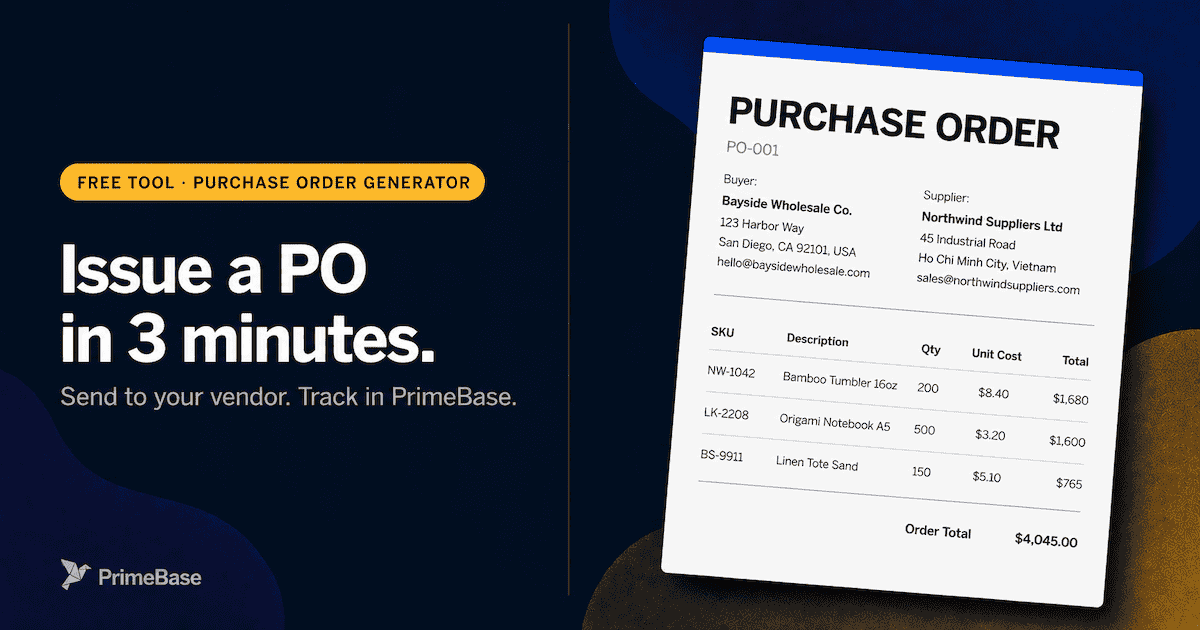
- 03Purchase order issuanceA PO is a formal, numbered document that commits your business to buying a specific quantity of goods or services at an agreed price. It's the transaction layer of vendor management — and the step most small businesses skip until they get burned. Without POs you have no baseline to match invoices against, no way to catch a 12-unit invoice for an 8-unit order, no audit trail when the IRS or your accountant comes asking. Every PO should include: PO number, issue date, required delivery date, line items with quantities and unit prices, shipping terms, and payment terms. Verbal orders need a written PO the same day — even a one-line email ("confirming our order of 50 units at $12 each, delivery March 15") creates the record. Once you're issuing POs consistently, the next step becomes possible. Without them, it doesn't.
- 04Receiving and three-way matchThe three-way match is the single most important AP control in vendor management. When an invoice arrives, you match it against (1) the original PO and (2) the goods receipt record. If all three agree, you approve it. If they don't, you hold the invoice until the discrepancy is resolved. The match catches: invoices for higher quantities than received, prices that drift from the PO, invoices for items not yet shipped, and the classic duplicate invoice on a PO you already paid. Northstack caught $14,000 of duplicate invoicing in their first year of running three-way match — not because their vendors were dishonest, but because invoice processing at most suppliers is messy. If a full three-way is too heavy, do a two-way (invoice vs PO only). It's still 80% of the protection at 20% of the work, and infinitely better than approving invoices on vibes.
- 05Payment processingOnce an invoice clears the match, it moves to payment. Vendor terms are typically Net-30, though you can negotiate Net-45 or Net-60 on larger orders and you'll see early-payment discounts (2/10 Net-30 means 2% off if you pay within 10 days) from suppliers who want predictable cash. The math on that 2/10 Net-30 is more interesting than it looks: skipping the discount is effectively borrowing money at roughly 36% APR. If you have the cash, take it. Pay in batches — weekly or bi-weekly, not invoice-by-invoice. Batching cuts bank fees, gives vendors a payment cycle they can plan around, and gives you a single window to catch any last-minute mismatches before money leaves the account. Clearwater's AP team moved to a Friday batch and reclaimed almost a day a week.
- 06Performance reviewMost small businesses never formally review vendor performance. They wait until something blows up, then react. A 30-minute quarterly review per critical vendor prevents most blow-ups. Three metrics cover 80% of what matters. On-time delivery rate — what percentage of orders arrived by the committed date? Target 95%+ for critical vendors. Quality reject rate — what percentage required return, rework, or complaint? Anything above 2% warrants a conversation. Response time — when you raise an issue, how fast does the vendor resolve it? Track these per vendor and share the data in your reviews. Vendors who consistently underperform give you grounds to renegotiate or source alternatives. Vendors who consistently outperform deserve to hear it — and the thank-you is what gets you preferred pricing when demand spikes and they're choosing whose order to ship first.
Documents to collect from every vendor
The single most common vendor failure at small business scale is the informal onboarding: vendor sends an invoice, you pay it, you move on. Six months later you realize you have no W-9, no insurance certificate, no signed terms — and the vendor has stopped answering email. Document collection feels like paperwork until the minute you actually need the documents. Then it's the cheapest insurance you ever bought.
The table below covers every document you should collect before issuing a first PO, why each one matters, when to ask for it, and what to do when one lapses. Treat the timing column as the rule, not the suggestion — once goods or services are flowing, your leverage to collect paperwork drops to roughly zero.
Vendor invoice management — the three-way match
Vendor invoice management is the discipline of receiving vendor invoices, matching them against the original purchase order and goods receipt, getting internal approval, and scheduling payment — without overpaying, double-paying, or paying for something that never arrived. At small business scale, the entire process should run on three documents and one rule: the three-way match.
The three-way match means before any vendor invoice gets paid, three documents must reconcile: (1) the purchase order you issued, (2) the goods receipt or service acceptance confirming what you actually got, and (3) the vendor invoice requesting payment. Line items, quantities, and prices on all three must agree. If they don't, the invoice goes back to the vendor for revision — not to your bank. Skipping the match is how Northstack caught $14,000 in duplicate invoices last year, all from a vendor who was sending the same charges through two different email addresses.
At small business scale, you do not need procure-to-pay software for this — a shared folder with three subfolders (POs sent, receipts logged, invoices to pay) and a Friday review run by one person is enough up to about 50 active vendors. Above that, the manual match starts to fail in predictable ways: invoices that match a PO that was never received, receipts logged against a vendor who never invoiced, and duplicates that slip through because nobody owns the cross-check. That's the threshold where vendor invoice management software earns its keep — and where the broader how-to-invoice guide becomes useful in reverse, helping you spot the patterns of a poorly constructed invoice landing in your AP queue.
Vendor risk management
Every vendor relationship carries risk. The only question is whether you've identified it in advance or whether you discover it the morning a critical delivery fails, an auditor opens a compliance file, or your SaaS provider's breach notification email lands in your inbox. Vendor risk management is just the practice of doing the first thing instead of the second.
You don't need an enterprise risk framework for this — at under 50 vendors, that's a job for nobody. What you need is enough vocabulary to know which of your vendors warrant closer scrutiny, and a handful of concrete mitigations for the top five names on your list. The five categories below cover everything that's likely to bite a small business.
Financial risk is the exposure you take on when a vendor's business deteriorates. If a key supplier goes under mid-order, you lose the deposit, the inventory isn't coming, and you need to source a replacement under time pressure — often at a premium. Mitigate this by checking vendor credit ratings or Dun & Bradstreet scores for high-spend suppliers, requiring performance bonds on large prepaid orders, and keeping a second qualified vendor on file for every critical category. Watch for early warning signs: repeated delays, requests for larger up-front deposits, turnover in account management, and slower response times — these often precede insolvency.
Operational risk is the day-to-day failure mode: late deliveries, wrong quantities, quality defects, or sudden stock-outs that halt your production or service delivery. The most common source of operational risk at small business scale is over-reliance on a single supplier for a critical input — one weather event, one port strike, one factory fire, and your supply chain stops. Mitigate by qualifying two suppliers per critical category, maintaining safety stock for your highest-velocity inputs, and setting contractual delivery window requirements in your vendor agreements. Track on-time delivery rate quarterly; anything below 90% on a critical-path vendor deserves a formal review.
Compliance risk arises when a vendor's operations — or their failure to maintain licenses, certifications, or regulatory standing — expose you to fines, audits, or reputational damage. In regulated industries (food, pharma, financial services, healthcare), this risk is existential. A food manufacturer that sources from a supplier without FDA registration can face product recalls; a financial services firm that uses a non-compliant data processor can face regulatory enforcement. Maintain a compliance calendar with expiry dates for every vendor's license, insurance certificate, and certification. Flag renewals 60 days out so you can pause purchases before a document lapses rather than scrambling to backfill compliance gaps after the fact.
Concentration risk is the danger of over-dependency on a small number of vendors. If one supplier accounts for more than 40% of your total spend in a critical category, a disruption to that vendor is a disruption to your entire operation — not just a line item problem. The same applies to geographic concentration: three suppliers in the same manufacturing region all face the same weather, tariff, and logistics disruptions simultaneously. Audit your vendor portfolio annually for concentration: which vendors represent your top-10 spend? Which categories have only one qualified source? Create a remediation plan for any single-source critical input — even if you never use the backup vendor, qualifying one changes your negotiating position with the primary.
Cybersecurity risk from vendors is the fastest-growing category of supply chain risk. A vendor who has access to your systems, handles your customer data, or integrates with your software stack is a potential attack vector — their breach becomes your breach. The 2020 SolarWinds attack and 2021 Kaseya breach both exploited trusted vendor relationships to compromise thousands of downstream customers. For software and SaaS vendors, require SOC 2 Type II reports annually, enforce SSO and MFA for any system with access to your data, audit vendor access scopes quarterly, and include data return and deletion rights in every contract. For service vendors with physical access, background check policies and badge logging are the minimum bar.
When you need a "vendor management system" — and when you don't
"Vendor management system" (VMS) is the enterprise term for platforms like Coupa, Jaggaer, or SAP Ariba — software that handles sourcing, contract lifecycle, PO management, invoice processing, and vendor portals at scale. They cost $30K–$200K+ per year, take three to six months to implement, and are built for organizations running hundreds of vendors and tens of millions in spend. They are not built for you.
For a business under 50 vendors, a dedicated VMS is a way to lose six months of your operations team's time. The threshold where one becomes genuinely worth the cost:
- 50+ active vendors — below this, a CRM with vendor records and a disciplined PO process in your accounting system covers the need.
- $5M+ annual vendor spend — at this level, even a 1% improvement in payment terms or supplier pricing more than covers the software cost.
- Regulated industries — healthcare, financial services, and food manufacturing often require formal audit trails that spreadsheets cannot provide.
- High vendor turnover — if you regularly onboard and offboard vendors, the administrative burden of informal onboarding becomes a real cost.
What small businesses actually need: a system that stores vendor records (same data model as customer records — payment terms, compliance docs, key contacts), an accounting tool that supports PO and bill matching, and the discipline to actually run the 6-step process above. A modern CRM with a vendor portal plus QuickBooks covers 90% of what most sub-50-vendor businesses need. Add inventory management if you're moving physical goods. If you're in wholesale or distribution — or architecture and construction with subcontractors and suppliers — the PO and three-way match discipline is non-negotiable.
IT vendor management — what's different
IT vendor management runs the same six steps as everything else, but the failure modes are different — and meaningfully more expensive. A late shipment of envelopes costs you a week. A SaaS vendor breach can cost you the company. Three things make IT vendors harder than physical goods suppliers.
SaaS sprawl
Most small businesses have far more active SaaS subscriptions than they realize. The typical 20-person company runs 30 to 60 distinct tools when you count departmental subscriptions, individual seats expensed to credit cards, and the tool somebody signed up for during a busy week in 2022 that's still auto-billing $89/month. Each one is a vendor relationship: a contract, a billing cycle, an access scope, a potential breach vector. Audit annually at minimum. Pull every recurring charge from your card and bank statements, match it to an owner, and cancel anything without one. Northwind's last audit turned up $11,400/year in subscriptions nobody could explain.
Security review requirements
Any SaaS vendor with access to customer data, financial records, or internal communications warrants a security review before onboarding. For enterprise and mid-market businesses, this means a formal vendor security questionnaire (often based on the SIG or CAIQ standard). For small businesses, a minimum bar is: requesting and reviewing the vendor's most recent SOC 2 Type II report, confirming they support SSO and MFA, and reviewing what data they store and how long they retain it. Document the review. If a vendor cannot produce a SOC 2 report for a system that touches sensitive data, that is a meaningful risk flag.
Contract clauses that matter for software
SaaS contracts contain several clauses that physical goods contracts do not. Three are critical for small businesses: data portability (can you export your data in a usable format when you leave?), data deletion (will they delete your data within a defined window after termination?), and uptime SLAs (what is the committed availability and what remedies apply for downtime?). Many SaaS vendors bury unfavorable terms in these clauses — particularly data portability, where vendor lock-in is a deliberate design choice. Review these before you sign, and negotiate where the stakes are high enough to matter.
SSO and access management
Every SaaS vendor that supports SSO (Single Sign-On) should be integrated with your identity provider (Google Workspace, Microsoft Entra, or Okta) rather than having standalone credentials. This means when an employee leaves, deprovisioning their access across all connected apps takes minutes instead of days, and there is no risk of forgotten active credentials in a tool someone stopped using. Track which vendors support SSO in your vendor records, and make SSO support a requirement for any new SaaS adoption above a certain spend threshold.
Common vendor management mistakes
After working with hundreds of small businesses on their vendor processes, the same six mistakes show up again and again. None of them is catastrophic the day it happens. Each one is the slow leak that costs you a few thousand dollars a year, plus the one quarter where it costs you a lot more. Catch them in your first read-through.
No onboarding documents
Approving a vendor before collecting W-9, insurance, and banking details creates a scramble at 1099 time and leaves you exposed to payment fraud.
No delivery dates on POs
A PO without a required delivery date is an open-ended commitment. Vendors optimize for their schedule, not yours. Always specify the date.
Paying invoices, not POs
Approving an invoice without matching it to a PO means you have no baseline to catch price discrepancies, duplicate invoices, or bills for goods you never received.
Single-source dependency
One qualified supplier per critical category means one disruption halts your operation. Always qualify a backup, even if you never use them.
No performance reviews
Without data, underperforming vendors stay on the roster. A quarterly on-time delivery check takes 15 minutes and identifies problems before they compound.
Missing 1099 documents
Failing to collect W-9s before year-end means you're chasing vendors in December for documents they have no incentive to provide quickly. Collect at onboarding.
Issue a professional PO in 3 minutes.
Line items, SKUs, shipping, terms — branded PO ready to send to your vendors. Live preview, instant PDF, no signup.
How PrimeBase handles vendor management
In PrimeBase, every vendor has a record alongside your customers — same data model, full history, every document attached. W-9s and other compliance documents sit on the vendor profile. Bills carry line items, due dates, and a status that follows them from received to approved to paid. Goods receipts (GRNs) post a journal entry to the GL the moment stock lands, so the books and the warehouse stay in sync. Vendors see their bills and payment status in their own portal — which means they stop emailing your AP team to ask "did you get my invoice?" three times a week.
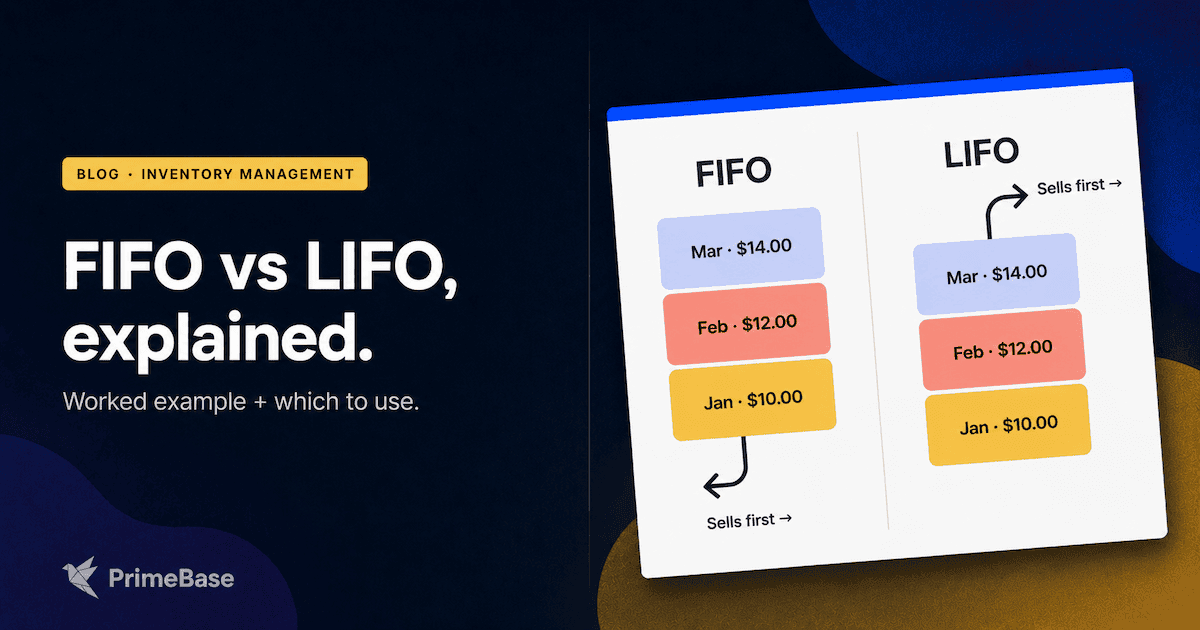
The portal gives suppliers a direct view into open bills and payment status without giving them access to anything else in your system. When a bill comes in, you review it against the matching GRN before approval — quantity off, price drift, line item that never shipped, and the mismatch surfaces before payment goes out. AP aging stays current in the accounting module, and 1099-NEC compliance data flows off the vendor record at year-end. If you also need to send invoices to your own customers, the same data model powers customer invoicing; if you're tracking physical inventory, the GRN-posted journal entry flows straight into your FIFO, LIFO, or weighted-average costing.
See how it works: vendor portal · accounting & AP aging · free purchase order generator
Frequently asked questions
Practical guides on SOWs, invoicing, client onboarding, and the tools that save real time — written for people who run service businesses.