A legally binding contract requires four elements: offer (one party proposes terms), acceptance (the other party agrees), consideration (something of value exchanged — usually money), and signatures from both parties. Beyond those basics, a well-written contract includes scope, payment terms, IP ownership, termination clauses, and a governing law jurisdiction.
What is a contract — and what makes one legally binding?
A contract is the agreement you can actually hand to a judge. Plenty of other agreements exist — handshakes, "sounds good" emails, verbal understandings on a Zoom call — but they aren't contracts in the legal sense, because they're missing one or more of the elements a court needs to hold the parties to their word.
Written beats oral every time, and the reason is boring: proof. A signed PDF tells a court exactly what was agreed, by whom, on what date. An oral agreement forces both sides to lean on memory and testimony — and memories get conveniently fuzzy once money is at stake.
A contract is also not the same thing as a proposal or a SOW, even though people use the words interchangeably. A proposal sells the work — not binding until something gets signed. A Statement of Work defines one specific project, usually under a master contract. The contract itself is the legal scaffolding underneath both: signed once, governs the whole relationship. If you only ever read one of our SOW guide and this one, read both — they're two halves of the same document set.
The 4 elements that make any contract legally binding
A $500 freelance gig and a $5M services agreement rest on the exact same four foundations. Miss any one of them and a court can decide the whole thing is unenforceable — which is the legal way of saying you have no contract, just a story about one. These 4 elements of a contract — offer and acceptance, consideration, and mutual intent with capacity — form the legal foundation of every binding agreement, anywhere in the world. Here's what each element actually means when you're sitting at your laptop drafting one.
Offer
An offer is a clear, definite proposal — specific enough that the other party could say "yes" and you'd both know exactly what they just agreed to. The keyword is definite. "We'd love to work with you someday" is not an offer. "Clearwater will deliver a 60-page market analysis by July 14 for $15,000" is.
Offers can be oral or written, but written ones leave a trail you'll want later. An offer stays open until it's accepted, rejected, countered, revoked, or expires after a reasonable time. In B2B work, the proposal or quote you send is usually the offer — which is why that document needs to be precise about scope and price, not aspirational.
Acceptance
Acceptance has to match the offer exactly. If the other side agrees but tweaks a material term — price, scope, deadline — that's a counter-offer, and the original offer is dead. Now you're the one being asked to say yes. This is the mechanism behind every "small edit" a client makes to your proposal before signing: legally, you're agreeing to a new contract, not the one you sent.
Silence is not acceptance. If you email a contract and hear nothing for three weeks, you don't have a deal — you have an unread PDF. Acceptance has to be communicated: a signature, a written reply, or (sometimes) starting the agreed work. A countersigned document is the cleanest version because it timestamps everything in one shot.
Consideration
Consideration is the thing each side gives up — money flowing one way, work flowing the other. Both directions matter. A promise to do something for nothing ("I'll just throw this one in") is a gift, not a contract, and gifts aren't enforceable. If you ever do free work for a client, document why (marketing, goodwill, sample) so it doesn't get folded into the next paid project's expectations.
Courts don't weigh whether consideration is fair — $1 for a house is technically valid consideration, though it raises other red flags. That's why you sometimes see the boilerplate phrase "for good and valuable consideration" in contracts: it asserts consideration exists without arguing about the amount. In your contracts, skip the Latin and just write the dollar number.
Mutual intent + capacity
Both sides have to mean it, and both sides have to be legally able to mean it. Capacity is where contracts quietly fall apart: minors under 18, anyone signing under duress, someone with a mental incapacity at the moment of signing, or — most relevant to B2B work — a person who doesn't actually have authority to bind their company.
Fraud and misrepresentation also kill the intent requirement. If your client signed because you told them something materially false, the contract can be unwound. The practical takeaway: confirm that the person signing on the other side has title and authority to bind the company. A contract countersigned by "the intern who handles paperwork" can be unenforceable against the organization later — and you won't know until you need it.
How to write a contract — the 8-step process
You don't need a JD to write a contract that holds up. You need to be specific, complete, and a little paranoid in eight specific places. Walk through these steps once, save the result as your template, and you'll be reusing it for the next hundred deals. If you want a head start, our free contract generator walks you through the same eight steps and outputs a clean PDF in about five minutes.
- 01Identify the partiesUse full legal names, not trade names or nicknames. Include addresses and entity types. 'Clearwater Consulting LLC, a Delaware limited liability company with its principal place of business at 200 Park Ave, New York, NY 10166' is correct. 'Clearwater' is not. Misidentifying a party is one of the most common ways a contract becomes hard to enforce — especially if you're contracting with an LLC rather than an individual. When you sue or get sued, the contract needs to name the right legal entity. If you're not sure whether you're dealing with a person, an LLC, or a corporation, ask before you draft.
- 02Define the scope of workThe scope section is the heart of the contract. It should be specific, bounded, and include explicit exclusions. 'Clearwater will deliver a 60-page market analysis report covering the US and European markets for enterprise software procurement, covering Q1–Q4 2026 data' is a scope. 'Consulting services' is not. List what you're doing, what format you're delivering it in, and what the work expressly does not include. Exclusions matter as much as inclusions — they're the thing you can point to six weeks later when the client asks for something that wasn't in the original deal. If it's not in the scope, it's a change order.
- 03Specify the payment termsPayment terms should answer five questions: how much ($15,000 total), in what currency (USD), on what schedule (50% upfront, 50% on delivery), with what invoicing lead time (invoices sent Net-15), and what happens if payment is late (1.5% per month on overdue balances, or work pauses after 10 days past due). Never leave payment terms to a verbal understanding — they're the most frequently disputed part of any contract. Include the method of payment you accept (ACH, wire, check) and who bears any transaction fees. State what triggers each payment milestone explicitly, especially if payments are tied to deliverable acceptance.
- 04Add timeline and deliverablesA deliverable without a due date is an aspiration. A due date without a definition of 'done' is a trap. For each deliverable, specify: what it is, when it's due, what format it's in, and how the client confirms acceptance. The acceptance window is critical: 'Client has 5 business days after delivery to provide written feedback; if no response is received, the deliverable is deemed accepted.' This closes out milestones and prevents projects from living in limbo. Also include assumptions about client responsibilities — if the timeline depends on the client providing information by a certain date, state that explicitly. If they're late, the schedule adjusts accordingly.
- 05Include confidentiality and IP clausesFor service contracts, the two most important questions are: who owns the work product, and what can each party say about the other? IP ownership typically goes to the client upon final payment — but spell it out. 'Upon receipt of final payment, Clearwater assigns all right, title, and interest in the work product to Hartwell Strategy Partners.' If you want to retain portfolio rights or the right to describe the engagement in a case study, carve that out explicitly. Confidentiality should run both ways: the client's business information is confidential to you; your methodologies may be confidential to them. Define what's excluded — information already publicly known, independently developed without reference to the confidential material, or required to be disclosed by law.
- 06Add termination conditionsTermination clauses cover three scenarios: (1) termination for cause — either party can exit if the other materially breaches and doesn't cure within 10 business days of written notice; (2) termination for convenience — the client can terminate with 30 days' written notice, paying for all work completed plus a kill fee equal to 25% of remaining contract value; and (3) mutual termination — both parties agree in writing to end the engagement. For each scenario, specify what happens to work in progress, who owns what's been delivered, and what fees are owed. The termination clause feels like fine print until you need it — at which point it's the only thing that matters. A well-written termination clause protects both parties and makes difficult endings professional rather than contentious.
- 07Specify governing law and dispute resolutionGoverning law determines which state's or country's law applies to the contract. Pick one jurisdiction — typically the service provider's location or the client's location, agreed in advance. Without a governing law clause, disputes may end up in courts in unexpected places. Dispute resolution specifies the process: (1) good faith negotiation (30 days), then (2) mediation (another 30 days), then (3) binding arbitration under AAA rules, or litigation in a specified court. Arbitration is generally faster and cheaper than litigation for business disputes under $500K; litigation gives you the right to a jury and full discovery. Whichever you choose, agree on it now — not when you're already in a dispute.
- 08Get signatures from both partiesBoth parties must sign — and sign with authority. If you're contracting with a company, confirm the signer has authority to bind the entity (ask for a title like CEO, COO, or VP with signing authority). Electronic signatures are valid for virtually all business contracts under ESIGN (US), eIDAS (EU), and most international equivalents. Include a counterparts clause: 'This Agreement may be executed in one or more counterparts, each of which shall constitute an original.' This allows parties to sign separately — critical for remote signing workflows. After signature, both parties should receive a copy of the fully executed document. Store it somewhere both sides can find it in 18 months.
Standard contract clauses every business should know
Most contract guides skip the standard clauses because they're boilerplate. They're boilerplate because they prevent specific kinds of disputes — every clause below is in your contract template because someone, somewhere, lost a lot of money the year that clause didn't exist. Here are the eight that earn their keep, and what each one actually prevents.
Confidentiality / NDA
A confidentiality clause protects both parties' non-public information shared during the engagement. It should define: what counts as confidential (typically anything marked confidential or that a reasonable person would understand to be confidential), how long the obligation lasts (1-3 years after the engagement, or perpetually for trade secrets), and what's excluded (publicly available info, independently developed knowledge, legally compelled disclosures). A standalone NDA signed before the engagement replaces this clause; if there's no NDA, add robust confidentiality language to the contract itself.
IP ownership
Intellectual property clauses define who owns the work product created during the engagement — and who retains rights to background IP (tools, frameworks, methodologies) each party brought in. For custom deliverables, IP typically assigns to the client upon final payment. Contractors often retain the right to use general methodologies and generic tools even after assignment. Specify this clearly: 'Upon final payment, Vendor assigns all right, title, and interest in the deliverables to Client, excluding Vendor's pre-existing IP and generic tools not specific to this engagement.'
Indemnification
An indemnification clause specifies who bears the cost if a third party makes a claim arising from the contract. Standard language: each party indemnifies the other against claims arising from their own negligence or breach. Service providers often indemnify clients against IP infringement claims (if they deliver content that infringes someone else's copyright). Clients often indemnify providers against claims arising from use of the deliverables after acceptance. Watch for broad indemnification clauses that make one party responsible for virtually anything — these are negotiating points, not boilerplate.
Limitation of liability
This clause caps the total damages one party can recover from the other, typically at the total fees paid under the contract or some multiple thereof. Without it, a service provider could theoretically be liable for the full economic consequences of a client's business decision based on their work. 'In no event shall either party be liable for consequential, indirect, incidental, or punitive damages.' This is one of the most negotiated clauses in B2B contracts — clients may push for uncapped liability for IP infringement or data breaches; service providers want the cap as low as possible. Know your number before you sign.
Force majeure
A force majeure clause excuses performance when extraordinary events beyond a party's control make it impossible or impractical: natural disasters, pandemics, government shutdowns, war. It should specify: what events qualify, how quickly the affected party must notify the other, how long the force majeure can continue before either party can terminate, and what happens to payments during the suspension period. Post-2020, many clients added pandemic language explicitly. For long-term contracts, this clause matters more than it might appear.
Severability
A severability clause ensures that if one provision of the contract is found unenforceable by a court, the rest of the contract remains in effect. Without it, a court could potentially void the entire contract if it finds one clause problematic. Standard language: 'If any provision of this Agreement is held to be invalid, illegal, or unenforceable, the remaining provisions shall continue in full force and effect.' This is mostly protective boilerplate — it rarely comes into play, but it's worth having to avoid the nuclear outcome of an entire contract being voided over one bad clause.
Entire agreement
Also called an integration or merger clause. It states that the written contract is the complete and final agreement between the parties, superseding all prior negotiations, representations, understandings, and agreements — oral or written. This prevents one party from claiming that a side conversation, email, or verbal promise modified the contract terms. Standard language: 'This Agreement constitutes the entire agreement between the parties with respect to its subject matter and supersedes all prior or contemporaneous agreements, representations, and understandings.' Any amendment must be in writing, signed by both parties.
Notices
The notices clause specifies how formal communications under the contract must be sent — and to whom. Typically: certified mail or overnight courier to the addresses in the contract header, with a specified number of days for delivery to be deemed effective. Also typically: email is acceptable for day-to-day communications but not for formal contract notices (termination, breach, etc.). Include specific names or titles and addresses for each party's notice contact, and state how address changes must be communicated. This clause becomes important if you ever need to start the clock on a breach cure period or termination notice.
Contract example — what a real service contract looks like
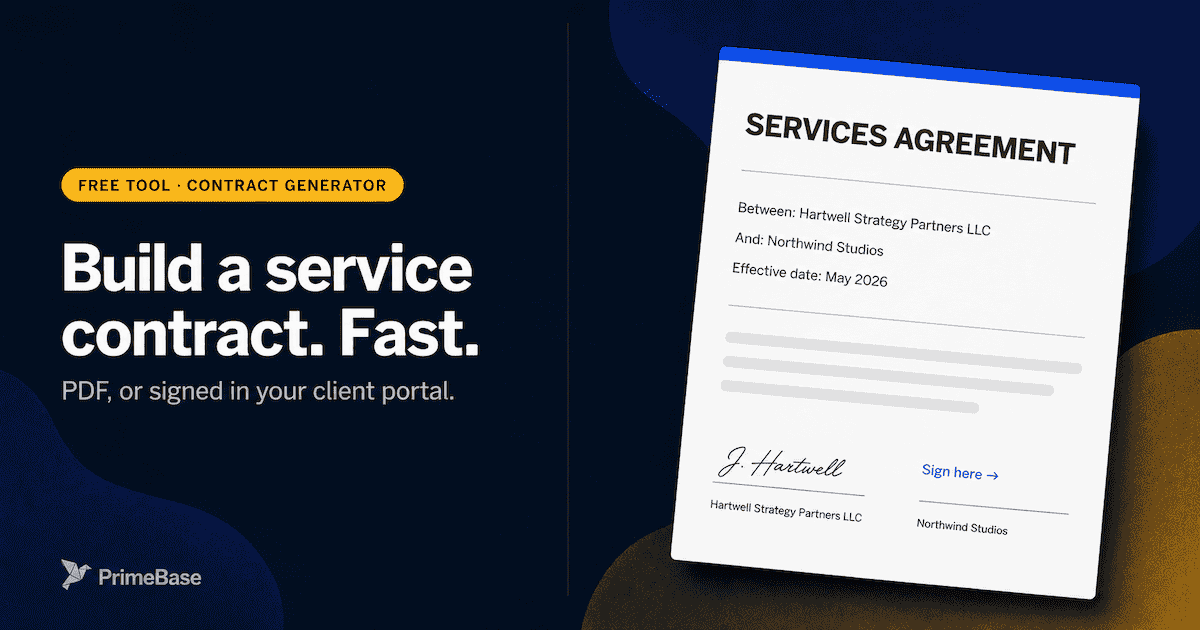
Here's what this all looks like when you stop talking about contracts and write one. Clearwater Consulting LLC is engaged by Hartwell Strategy Partners for a 2-month market analysis: fixed fee $15,000, two milestone payments, four sections shown — scope, payment, confidentiality, termination — with signature blocks at the bottom.
Notice what's nailed down: specific party names with their entity type spelled out, a bounded scope with explicit exclusions, exact dollar figures with a late-payment provision, and a termination clause that handles both for-cause and convenience. That precision is the entire difference between a $15,000 engagement and a $15,000 lawsuit.
Build a service contract in 5 minutes.
An 8-step guided builder for parties, scope, deliverables, payment, and all standard clauses — pre-filled with a consulting example. Live preview, instant PDF, no signup.
DIY contract vs hiring a lawyer — how to decide
Whether you need a lawyer comes down to deal value, complexity, and risk — not how much you enjoy paperwork. Most standard B2B service contracts under $25K in a single jurisdiction are fine on a solid template. Once you cross into larger, more complex, or cross-border deals, the $300–$1,500 you spend on an attorney review is the cheapest insurance you'll ever buy.
Write it yourself when…
- Deal value is under $25K
- Both parties are in the same jurisdiction
- Work is a standard service (consulting, design, copywriting, development — see the full agency playbook)
- No complex or unusual IP arrangements
- No regulated industry requirements (finance, health, legal, real estate)
- Relationship is relatively straightforward and low-stakes
Get a lawyer when…
- Deal value is over $50K
- Parties are in different countries
- Complex or high-value IP licensing or assignment
- Regulated industries: healthcare, finance, real estate, employment
- M&A, equity, or investment agreements
- You're the client on a large vendor's paper (their lawyers wrote it for their benefit)
The move most service businesses miss: for your first contract in a new type of deal, pay a lawyer once. Sit down for the 30-minute walkthrough, take notes on every redline, and ask why each change was made. That annotated template becomes your reusable standard for the next 50 similar engagements — so you're paying $500 once instead of $500 every time.
Common contract mistakes (and how to avoid them)
After hundreds of service contracts, the same six mistakes show up on repeat. The good news: every one of them is avoidable with a decent template and one slow read-through before you send. The other good news: if you fix these six, you're ahead of about 80% of the contracts you'll ever receive from clients.
Vague scope
Defining the work in two sentences and fighting about it for months. If scope is ambiguous, the party with more leverage wins — and it's rarely the service provider.
Missing termination clause
No clean exit means every bad engagement becomes a hostage situation. Without a termination clause, you're stuck until both sides agree — and they may not.
No defined completion trigger
"Done" means different things to different people. Without a specific acceptance process, projects drag forever and final invoices stall indefinitely.
Hand-shake amendments
Verbal changes don't survive disputes. If a client asks for more work and you just do it, you've created an unwritten obligation with no paper trail and no additional payment right.
Wrong jurisdiction clause
Enforcing a contract in the wrong court is expensive and sometimes impossible. A California contract being litigated in New York courts, for a client in Germany, is a mess.
Outdated boilerplate
A 2015 NDA template in 2026 is missing GDPR language, modern eSignature validity clauses, and post-pandemic force majeure provisions. Date-stamp your templates and review them annually.
How to sign a contract — digital signature, electronic signature, or wet ink
A contract is unsigned theater. Signatures are what convert your draft into a legally binding agreement — and in 2026, the way you collect them matters almost as much as what they sign. The terminology trips most people up, so let's start there.
Electronic signature vs digital signature — what's the difference?
An electronic signature is the broad legal category: any sound, symbol, or process attached to a record with the intent to sign it. Typing your name into a DocuSign envelope is an electronic signature. So is drawing your initials with your finger on a phone screen. So, technically, is replying “I accept” to an email — though that one is harder to defend in court without supporting metadata. Electronic signatures are explicitly legally binding under ESIGN (US, 2000), UETA (US, 49 states), eIDAS (EU, 2014), and equivalent statutes in essentially every developed jurisdiction.
A digital signature is a specific cryptographic technology used to implement a higher-trust electronic signature. It uses public-key cryptography to bind a signer's identity to a document in a way that's tamper-evident — any change to the document after signing invalidates the signature. Adobe Sign, DocuSign, and PrimeBase's built-in eSignature all use digital signature technology under the hood. From a legal standpoint, a digital signature is an electronic signature with cryptographic audit trail — the strongest type of e-signature you can collect without a notary.
Which to use, when
- Standard service contracts under $100K, same-jurisdiction parties: a digital signature through a reputable eSignature platform is the right tool. Faster than wet ink, auditable, and accepted by every court that matters.
- International contracts in the EU: for highest legal certainty, use a qualified electronic signature (QES) under eIDAS — the EU's top tier, requiring a government-issued digital ID. Most B2B contracts don't need this, but regulated industries do.
- Real estate transfers, wills, court documents: wet ink may still be required depending on jurisdiction. Check local law before relying on electronic signatures for any of these.
- Anyone who refuses to use eSignature: print, sign, scan, email back. It works, it's legally identical to a digital signature for most contracts, and it's not worth a fight.
What can go wrong
Three things kill an otherwise-valid signing process. Authority: the person who signs must actually have authority to bind the entity. “Marketing intern with a corporate email” doesn't. Confirm a title and ask for a verbal “yes, I have authority to sign this for [Company]” on a recorded video call if the deal value warrants it. Counterparts: if you sign separately (which is normal for remote work), include a counterparts clause stating that signatures collected separately constitute one original document — or both signatures need to appear on the same physical/PDF page. Version control: sign the final version, not a draft. Add a small footer to the executed PDF: “v2.1 — Executed [Date].” If anyone ever pulls a different version off email, the executed one wins.
How PrimeBase handles contracts
Most contract disputes aren't about what was written — they're about which version got signed, where it lives, and who can find it eight weeks later when scope drifts. PrimeBase fixes that part of the problem, not the legal part. You build a contract template once. New clients sign it inside their portal — no DocuSign tab, no email envelope, no “where's the signed copy?” in week six. The countersigned PDF lives on the client record alongside the project, invoices, and other documents — one place, not five.
The result: when a scope question comes up two months in, the project manager opens the contract in two clicks, points to Section 1, and the conversation is over. Same for every invoice line item, every change order, every renewal.
- Documents & eSignature — build templates, send for signature, store executed contracts on the client record.
- Free contract generator — build a service contract in 5 minutes with a guided template. No signup required.
- Everything connects on the customer record: the contract, the project, the invoices, and the client portal all reference the same engagement. From here you're ready to send the first invoice and run onboarding off the same record.
Frequently asked questions
Practical guides on SOWs, invoicing, client onboarding, and the tools that save real time — written for people who run service businesses.